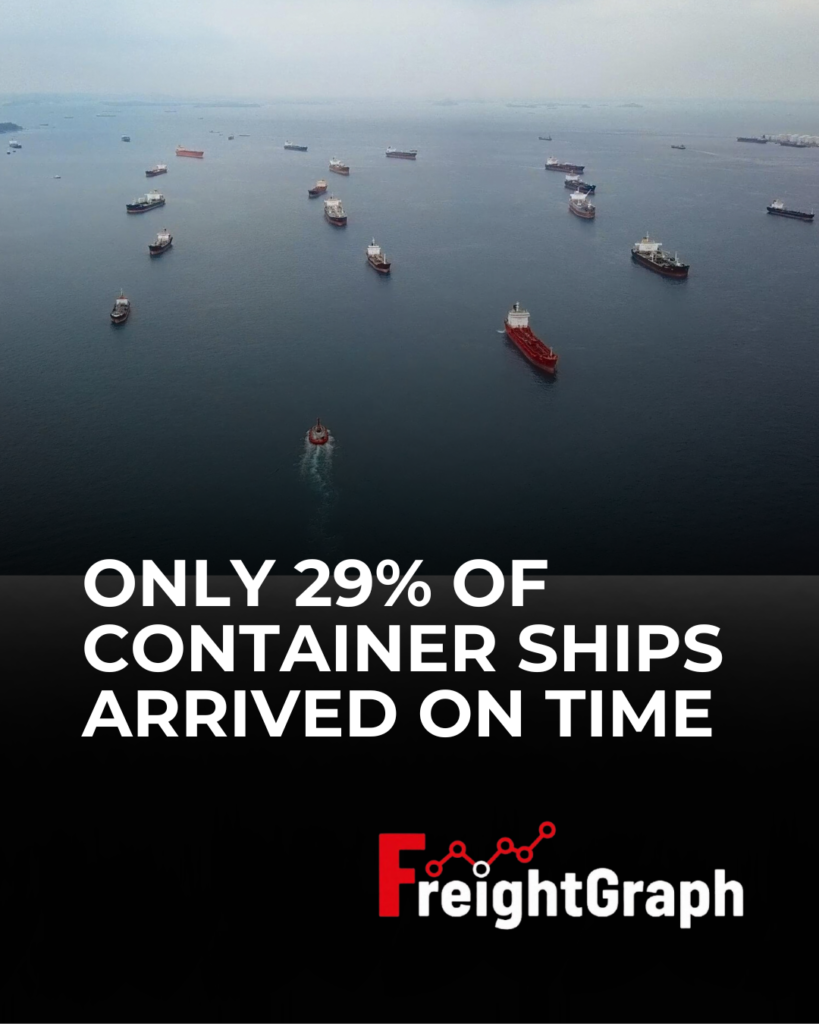
Global container shipping schedule reliability fell for the third consecutive month in August, with only 29% of vessels arriving on time, according to Xeneta. The figure dropped from 33% in July, while the average delay increased from 4.2 days to 5.1 days. The deterioration brings global schedule reliability close to some of the weakest levels seen during recent years of major supply-chain disruption.
The Far East–Europe trade lane was at the center of the decline. Schedule reliability on the route fell by 10 percentage points to just 6%, with vessels arriving an average of 8.2 days late. Xeneta linked the disruption to a combination of longer routings around the Cape of Good Hope, North European port congestion, longer berth stays for larger vessels and weather-related disruption in Asia. Four consecutive typhoons in China also contributed to congestion, with around 1.1 million TEUs held at anchorage across Ningbo, Shanghai and Yantian in the week following Typhoon Saudel.
For shippers, lower schedule reliability means more uncertainty around ETAs, inventory planning, port operations and downstream deliveries. With China’s Mid-Autumn Festival and Golden Week approaching, Xeneta expects capacity and equipment availability to remain under pressure. In an environment where shipment information is increasingly critical, solutions such as FreightGraph AutoFill can help logistics teams turn freight documents and information into structured digital data, supporting more efficient document workflows as supply-chain conditions become harder to manage.