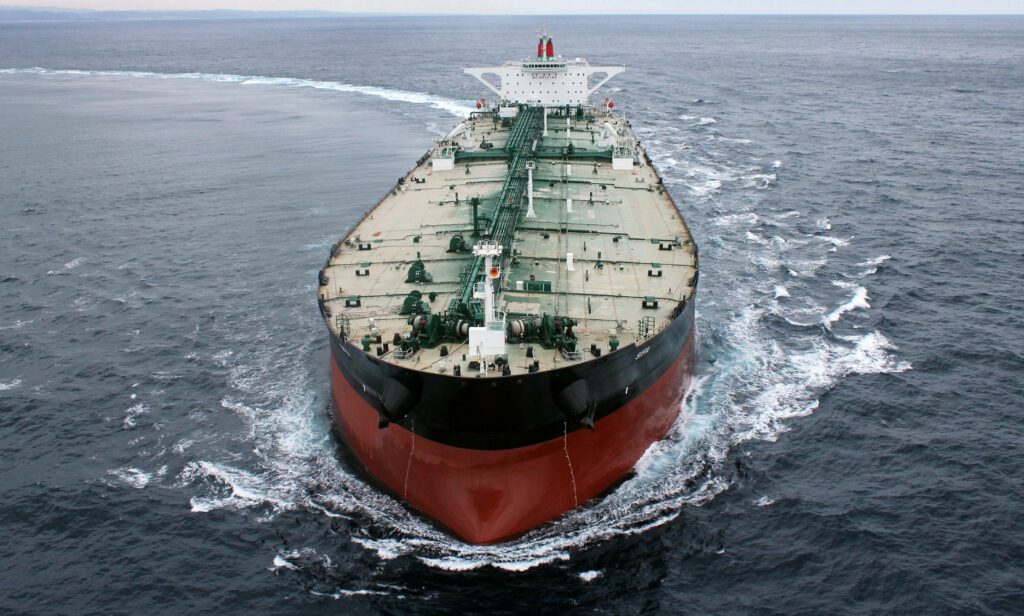
Ship-to-ship oil transfers orchestrated by the United States military near the edge of the Strait of Hormuz have quietly moved an estimated 90 million barrels of Gulf crude, condensate, and petroleum products since early May 2026 — a covert logistics operation that borrows directly from Iran’s own sanctions-evasion playbook, according to a Reuters investigation published June 16.
The operation, conducted at two offshore sites — one off Fujairah in the UAE and another near the Omani port of Sohar — involves U.S. aerial drones, water drones, and helicopters guiding convoys of state-owned Gulf tankers to internationally operated receiving vessels waiting beyond the contested strait. Reuters reviewed more than a dozen satellite images taken between May 2 and June 11 confirming the activity.
Key Facts for Freight & Energy Professionals
- At least 92 ships involved across two offshore transfer zones (Fujairah, UAE and Sohar, Oman)
- 17 simultaneous ship-to-ship pairs observed on June 11, 2026 alone
- ADNOC (UAE) and Kuwait Oil Tanker Company among the most active participants
- One cargo: 2.3 million barrels transferred off Sohar on June 6 — bound for China via India
- A U.S. Apache helicopter involved in the mission was downed by Iran on June 9; both crew rescued by drone boat
- Pre-war Hormuz throughput averaged ~20 million barrels/day; current STS volumes remain well below that level
- U.S. President Trump announced a framework Iran peace deal that would reopen Hormuz on Friday, but details remain unconfirmed
Borrowing Iran’s Playbook
The ship-to-ship technique has been used by Iran for years to mask the origin of its sanctioned oil exports — typically operating one pair of ships at a time to avoid detection. The U.S.-led operation scales this dramatically: multiple simultaneous transfer pairs, military escort, and drone surveillance replace the furtive, low-volume Iranian approach with an industrialised logistics chain.
Despite the scale of the operation, the U.S. Department of Defense denied involvement. “No Central Command forces are taking part in an offshore ship-to-ship oil transfer operation,” a U.S. defense official told Reuters in response to direct questions.
What It Means for Tanker Markets and Freight
The operation represents a significant structural change in how Gulf crude reaches global buyers. Vessels are sailing beyond normal port procedures, loading offshore, and routing through alternative waypoints — adding voyage time, operational complexity, and risk premium for insurers and charterers alike. Shipping data from LSEG and Kpler confirmed repeated tanker rendezvous in the area during the May–June window.
The receiving vessels are then sailing independently to end-markets. One notable cargo: a Kuwait Oil Tanker Company ship offloaded 2.3 million barrels off Sohar on June 6. The receiving vessel, Sea Ruby, was subsequently tracked heading toward India’s southwest coast, with China as the expected discharge destination — a route that bypasses the Strait entirely.
President Trump’s announcement of a framework peace deal with Iran — which he said would reopen the Strait of Hormuz by Friday — has introduced uncertainty about the future of the STS operation. Reuters was unable to confirm whether the deal had already affected transfer activity. If the Strait reopens fully and sustainably, the logistical and cost pressures these transfers impose on Gulf producers could ease rapidly. If it does not, the offshore STS network may become a semi-permanent fixture of Gulf energy logistics for months ahead.