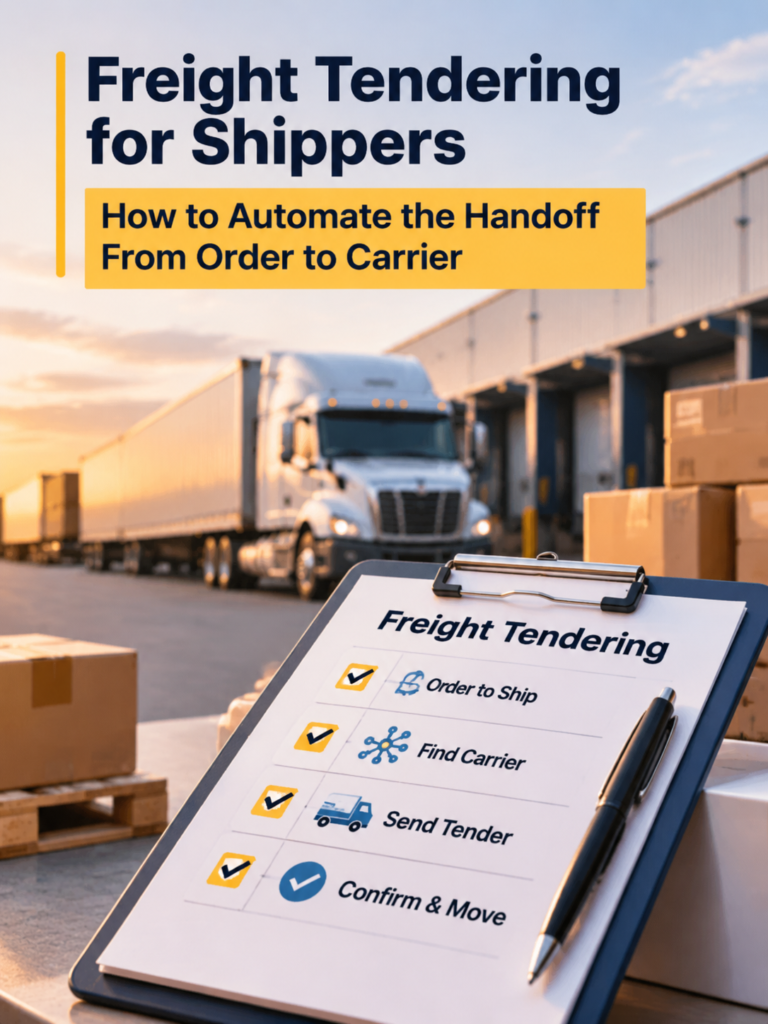
Freight Tendering for Shippers: How to Automate the Handoff From Order to Carrier
Freight tendering plays an important role in transportation management. However, many shippers still rely on manual processes to move orders from their systems to carriers. Orders arrive through emails, PDFs, and disconnected platforms. Logistics teams must review shipment details, find suitable carriers, send load offers, and wait for confirmation.
These activities take time and create opportunities for errors. As shipment volumes grow, manual work can slow down the entire transportation process.
Freight tendering automation helps shippers connect order information, carrier selection, and tender responses in one structured workflow. With accurate shipment data and better coordination, transportation teams can reduce repetitive tasks and manage carrier assignments more efficiently.
This guide explores how freight tendering works, why manual handoffs create problems, and how shippers can automate the process while maintaining control over transportation decisions.
What Is Freight Tendering for Shippers?
Freight tendering is the process of offering a shipment to a carrier and requesting confirmation that the carrier can transport it under the required conditions.
Once a shipper prepares an order for transportation, the logistics team must assign it to a suitable carrier. The carrier reviews the shipment details and either accepts or rejects the offer.
A typical freight tender includes:
- Pickup and delivery locations
- Scheduled pickup and delivery windows
- Commodity information and shipment weight
- Equipment and handling requirements
- Shipment reference numbers
- Special instructions and transportation terms
Freight tendering differs from freight procurement. Procurement establishes carrier relationships, negotiates rates, and secures transportation capacity. Tendering applies those agreements to individual shipments during daily operations.
For shippers that manage multiple facilities, transportation lanes, and carrier relationships, an organized tendering process supports more reliable execution.
Why Manual Freight Tendering Slows Down Shippers
Many tendering problems begin before a carrier receives the shipment offer.
Shipment information often arrives through purchase orders, shipping instructions, emails, PDFs, and spreadsheets. Transportation coordinators must collect these details, enter them into a Transportation Management System (TMS), and resolve missing information before selecting a carrier.
Manual Data Entry Creates Delays
Transportation teams often copy shipment details from one document or system into another. Every order requires additional administrative work.
As shipment volumes increase, these repetitive tasks can become a bottleneck. Delays during order preparation also affect carrier selection and transportation planning.
Incomplete Shipment Data Creates Problems
Missing delivery appointments, incorrect weights, or unclear equipment requirements can prevent carriers from evaluating a tender accurately.
These issues may lead to clarification requests, rejected tenders, and last-minute changes.
Fragmented Communication Reduces Visibility
Shippers and carriers may exchange tender information through emails, phone calls, portals, and EDI messages.
When these channels operate separately, transportation coordinators must track responses across multiple systems. They also need to update shipment records to reflect the latest carrier decisions.
Rejected Tenders Require Additional Work
When a preferred carrier declines a shipment, the transportation team must find another suitable option.
Without predefined fallback rules, employees may need to repeat the selection and communication process manually. This becomes especially challenging when pickup deadlines approach.
The real problem goes beyond administrative workload. Transportation decisions depend on how quickly teams can collect, verify, and communicate accurate shipment information.
How the Freight Tendering Process Works
A standard freight tendering workflow connects transportation requirements with carrier confirmation.
The exact steps vary by shipper and TMS, but most operations follow a similar process.
1. Receive and Validate the Freight Order
The process starts when shipment requirements become available through an ERP, order management platform, warehouse system, or incoming document.
The transportation team checks the information for completeness and accuracy before moving forward.
2. Identify Eligible Carriers
The TMS or transportation team evaluates potential carriers based on the shipment requirements.
Important factors include lane coverage, equipment compatibility, available capacity, contracted rates, and service expectations.
3. Send the Freight Tender
The shipper sends the shipment offer through an appropriate communication channel.
Common options include EDI, APIs, carrier portals, and email. The tender contains the shipment details and requests carrier confirmation.
4. Receive Carrier Acceptance or Rejection
The carrier reviews the offer and sends a response.
An accepted tender allows the shipment to move toward dispatch and execution. A rejected offer or missing response requires further action.
5. Confirm the Carrier Assignment
After acceptance, the shipper records the confirmed carrier in the transportation system.
The updated record supports dispatch coordination, shipment visibility, documentation, and freight settlement.
Accurate shipment data and timely carrier communication are essential to an effective tendering process. Automating only the final communication step leaves many upstream inefficiencies unresolved.
How to Automate the Order-to-Carrier Handoff
Effective freight tendering automation connects the activities that happen before, during, and after a carrier receives a shipment offer.
The goal is to reduce repetitive work while keeping people involved in important decisions and exceptions.
Step 1: Capture Shipment Information Automatically
Shipment details often arrive in different formats, including emails, PDFs, bills of lading, and customer-specific documents.
Document automation can extract relevant fields and organize them into structured shipment data.
These fields may include:
- Origin and destination
- Pickup and delivery dates
- Shipment weight
- Equipment requirements
- Commodity details
- Reference numbers
Automatic extraction reduces manual re-entry and helps transportation teams prepare freight orders more efficiently.
Step 2: Validate Data Before Carrier Selection
Extracted information needs validation before it enters the transportation workflow.
For example, missing delivery windows, conflicting weights, and incomplete addresses can affect carrier selection. Validation rules help identify these issues before the system moves forward.
Some exceptions require human review. Transportation coordinators should verify important discrepancies before approving the shipment data.
Step 3: Make the Freight Order Available to the TMS
After validation, the shipment information must reach the system responsible for transportation planning and execution.
Depending on the technology environment, this step may involve creating a shipment record, updating an existing freight order, or triggering a configured workflow.
The objective is simple: maintain consistent shipment information without asking employees to enter the same details repeatedly.
Step 4: Evaluate and Rank Suitable Carriers
With accurate shipment data available, the transportation system can evaluate eligible carriers.
Configured business rules may consider equipment requirements, lane coverage, capacity, contractual rates, and service performance.
A ranked list helps transportation teams identify suitable options before sending the tender.
Step 5: Send the Tender and Monitor Responses
The tendering system communicates the shipment offer and tracks the carrier’s response.
Response deadlines help prevent shipments from remaining indefinitely assigned to an unanswered tender.
Transportation teams can monitor acceptance, rejection, and pending responses through the configured workflow.
Step 6: Handle Rejections and Exceptions
When a preferred carrier declines the shipment, configured routing rules can direct the offer to another eligible carrier.
However, some exceptions require manual attention. Capacity shortages, unusual shipment requirements, and changes in transportation costs may need additional review.
Step 7: Record Confirmation and Continue Execution
Once the carrier accepts the tender, the transportation system records the confirmed assignment.
The shipment can then move into dispatch coordination, tracking, documentation, and other execution activities.
A connected workflow reduces unnecessary handoffs and gives transportation teams a clearer view of shipment progress.
Automated Carrier Selection and Freight Matching
Carrier selection is one of the most important decisions in freight tendering.
The lowest available rate does not always represent the best transportation option. Shippers must also consider whether a carrier meets the operational requirements of the shipment.
Equipment and Shipment Compatibility
The carrier must have equipment that suits the commodity, shipment weight, dimensions, and handling requirements.
For example, a refrigerated shipment requires suitable reefer equipment. Geographic availability alone cannot determine whether a carrier qualifies.
Lane Coverage and Available Capacity
A carrier may offer competitive rates but lack capacity on a specific lane or pickup date.
Capacity information helps transportation teams identify realistic options before issuing a tender.
Service Performance and Delivery Requirements
Pickup reliability, on-time delivery performance, and the ability to meet appointment requirements all influence carrier suitability.
Contractual Rates and Business Priorities
Shippers may also consider negotiated rates, preferred carrier relationships, and contractual capacity commitments.
According to SAP Learning’s guide to carrier selection and tendering, transportation systems can evaluate defined constraints and rank eligible carriers.
Freight matching supports this process by helping teams identify and compare suitable load and carrier options.
However, freight matching and freight tendering serve different purposes. Matching identifies potential transportation options. Tendering sends a shipment offer to a carrier and obtains acceptance or rejection.
Shippers should understand this distinction when building connected transportation workflows.
Routing Guides, Tender Rejections, and Backup Carriers
A routing guide defines how shippers prioritize carriers for specific shipments, lanes, or transportation requirements.
Traditional routing guides often place carriers in a predetermined order based on contractual relationships and service priorities.
Automated tendering systems can apply these rules without requiring transportation coordinators to contact every carrier manually.
Sequential Tendering
Sequential tendering offers a shipment to one carrier at a time.
If the first carrier rejects the offer or fails to respond before the deadline, the system can offer the shipment to the next eligible carrier.
This method works well when shippers want to follow a preferred carrier hierarchy.
Broadcast Tendering
Broadcast tendering sends a shipment opportunity to multiple eligible carriers.
The shipper’s tendering platform applies its configured response and award rules to manage the offers.
Spot-Market Fallback
Sometimes contracted carriers cannot provide the required capacity.
In these situations, the shipper may need to source transportation through the spot market. This can introduce additional costs and operational uncertainty, particularly for time-sensitive shipments.
Exception Management
Not every rejected tender should trigger another offer automatically.
Incomplete documentation, changing pickup requirements, and unusual handling restrictions may require human intervention.
Effective routing strategies combine automated fallback rules with clear escalation procedures.
EDI, APIs, and TMS Integration for Freight Tendering
Freight tendering automation depends on reliable communication between shippers, carriers, and transportation systems.
Several technologies support this information exchange.
EDI 204: Motor Carrier Load Tender
EDI 204 provides a standardized format for sending motor carrier shipment offers and load information.
Shippers use this transaction to communicate tender details electronically.
EDI 990: Response to a Load Tender
EDI 990 communicates the carrier’s response to a motor carrier load tender.
It helps shippers record whether the carrier accepts or declines the offer.
EDI 214: Transportation Carrier Shipment Status
EDI 214 communicates shipment status information during transportation execution.
Unlike EDI 990, which handles tender responses, EDI 214 supports shipment visibility after the transportation process begins.
APIs and Carrier Portals
APIs support direct communication between connected systems. Carrier portals give transportation partners an interface for reviewing and responding to shipment offers.
Email may also remain part of the process, especially when carriers use different technology platforms.
The objective is not to eliminate every communication channel. Shippers need consistent shipment information and clear visibility across all supported channels.
A well-integrated TMS helps teams monitor tender status, record carrier confirmations, and identify exceptions that require attention.
Key KPIs for Freight Tendering Automation
Shippers need measurable indicators to determine whether automation improves transportation performance.
A useful KPI framework should measure speed, carrier acceptance, process reliability, and manual workload.
| KPI | What It Measures |
|---|---|
| Tender Acceptance Rate | Percentage of tender offers accepted by carriers |
| First-Tender Acceptance Rate | Percentage of shipments accepted by the first carrier |
| Time to Carrier Confirmation | Time between issuing the tender and receiving acceptance |
| Tender Rejection Rate | Percentage of tender offers declined by carriers |
| Routing Guide Compliance | Percentage of applicable shipments assigned according to routing guide rules |
| Spot-Market Fallback Rate | Percentage of shipments requiring spot-market sourcing |
| Manual Touches per Shipment | Number of manual interventions during the order-to-carrier process |
Teams should evaluate these metrics together.
For example, a high overall acceptance rate may hide repeated rejections when shipments require several tender attempts.
Similarly, faster carrier confirmation does not always indicate better performance if transportation costs increase or service requirements suffer.
Shippers should also track incoming shipment data quality. Missing fields, validation exceptions, and manual corrections can reveal problems that affect tendering before a carrier receives the offer.
Freight Tendering Automation: A Practical Shipper Example
Consider a manufacturer arranging a refrigerated shipment from Dallas, Texas, to Atlanta, Georgia.
The shipment requires a reefer trailer, weighs 36,000 pounds, and has a pickup window between 2:00 PM and 4:00 PM.
The manufacturer receives the shipping requirements through an email with a PDF attachment.
Without Automation
A transportation coordinator opens the email and reads the attachment. Next, the coordinator enters the shipment details into the TMS and verifies the equipment requirements.
After checking available carriers, the coordinator sends the shipment offer.
If the preferred carrier declines, the coordinator must identify another option and repeat the communication process.
Several manual steps stand between the original order and confirmed transportation.
With a Connected Automation Workflow
First, the system captures shipment information. Document automation extracts the origin, destination, weight, pickup window, and equipment requirements from the incoming information.
Next, validation rules check the extracted data. The system flags missing or conflicting fields before the shipment moves forward.
Then, the transportation system receives the approved freight order. The validated information becomes available for transportation planning.
Carrier matching follows. The system evaluates suitable options using shipment requirements and available carrier information.
Finally, the configured tendering workflow manages communication and confirmation. The selected carrier receives the shipment offer and sends a response. The TMS records the outcome.
If the carrier declines, the shipper’s routing rules determine whether another carrier should receive the offer or whether the team should review the shipment.
This illustrative example shows how document processing, carrier matching, and tender management can operate as connected stages rather than separate manual tasks.
Where FreightGraph Fits Into the Freight Tendering Workflow
Freight tendering automation starts before the shipper sends a carrier offer. It begins when shipment information becomes available for operational use.
FreightGraph supports two important stages of this broader process. To begin with, its AI-powered tools help transportation teams prepare shipment data and identify suitable carrier options.
FreightGraph AutoFill: Preparing Shipment Data
For document processing, AutoFill uses AI to extract shipment information from freight documents and messages. This includes emails, bills of lading, rate confirmations, invoices, PDFs, and other freight-related files.
Supported document sources include emails, bills of lading, rate confirmations, invoices, PDFs, and other freight-related files.
AutoFill can map extracted information to configured freight fields, validate data, flag exceptions for review, and deliver approved information to connected logistics systems.
This helps transportation teams reduce repetitive document-processing work before carrier selection.
FreightGraph Freight Matching: Supporting Carrier Decisions
FreightGraph Freight Matching helps identify and rank suitable freight and carrier options using available shipment and capacity information.
This supports the carrier evaluation stage, where transportation teams must determine which options meet the shipment’s operational requirements.
Learn more about FreightGraph Freight Matching and its role in data-driven freight operations.
Connecting the Workflow
AutoFill and Freight Matching address two related challenges: preparing reliable freight data and identifying suitable transportation options.
The next steps, including tender communication, carrier acceptance, and shipment execution, depend on the capabilities and configuration of the shipper’s TMS and connected systems.
This distinction matters because successful automation requires clear responsibilities across the technology stack.
Rather than replacing every transportation platform, shippers can focus on improving the stages where disconnected information and manual decisions create the greatest delays.
Common Freight Tendering Automation Mistakes
Even well-designed automation initiatives can underperform when teams overlook important operational requirements.
Automating Inaccurate Shipment Data
Sending tenders faster does not help when the underlying shipment information contains errors.
Shippers should establish data validation rules before automated carrier selection and tender communication.
Selecting Carriers Based Only on Price
A low rate does not guarantee suitable equipment, available capacity, or reliable service.
Carrier evaluation should account for each shipment’s operational requirements.
Ignoring Tender Response Deadlines
Without clear response windows, shipments may remain unresolved while pickup deadlines approach.
Timeout and escalation rules help transportation teams maintain control over the process.
Overlooking Carrier Communication Differences
Not every carrier uses the same technology.
Shippers should consider EDI, APIs, portals, and other supported communication channels when designing their workflows.
Measuring Automation Without Operational KPIs
Reducing manual work is valuable, but teams should also measure acceptance performance, confirmation time, routing guide compliance, and exceptions.
The goal of automation is to improve transportation execution, not simply increase the number of automated actions.
Frequently Asked Questions About Freight Tendering
What Is Freight Tendering in Logistics?
Freight tendering is the process of offering a shipment to a carrier and obtaining confirmation that the carrier can transport it under the required conditions.
What Is Freight Tendering Automation?
Freight tendering automation uses configured systems and business rules to reduce manual work involved in preparing shipment information, selecting carriers, communicating tenders, tracking responses, and handling exceptions.
What Is the Difference Between Freight Matching and Freight Tendering?
Freight matching identifies suitable transportation options based on shipment and carrier information. Freight tendering sends the shipment offer to a carrier and obtains acceptance or rejection.
What Happens When a Carrier Rejects a Freight Tender?
The shipper may offer the shipment to another eligible carrier, follow a routing guide, source spot-market capacity, or escalate the shipment for manual review.
Can Freight Tendering Be Automated Without Replacing an Existing TMS?
In many cases, shippers can introduce automation through integrations, document processing, and configured workflows that support an existing TMS. The available options depend on the platform’s capabilities and integration requirements.
Which Freight Tendering KPIs Matter Most?
Important KPIs include first-tender acceptance rate, overall tender acceptance rate, time to carrier confirmation, tender rejection rate, routing guide compliance, and manual interventions per shipment.
Conclusion: Better Freight Tendering Starts Before the Tender
Freight tendering involves more than communication between a shipper and a carrier. It connects shipment information, carrier selection, transportation requirements, and execution.
For shippers, meaningful automation starts with accurate and accessible freight data.
When teams capture, validate, and organize shipment information before carrier selection, they can reduce repetitive work and make better transportation decisions.
FreightGraph supports this foundation through AI-powered freight document processing and data-driven freight matching.
Together, these capabilities help create a more connected approach to freight operations, where reliable data supports better decisions from the initial order through carrier selection and beyond.