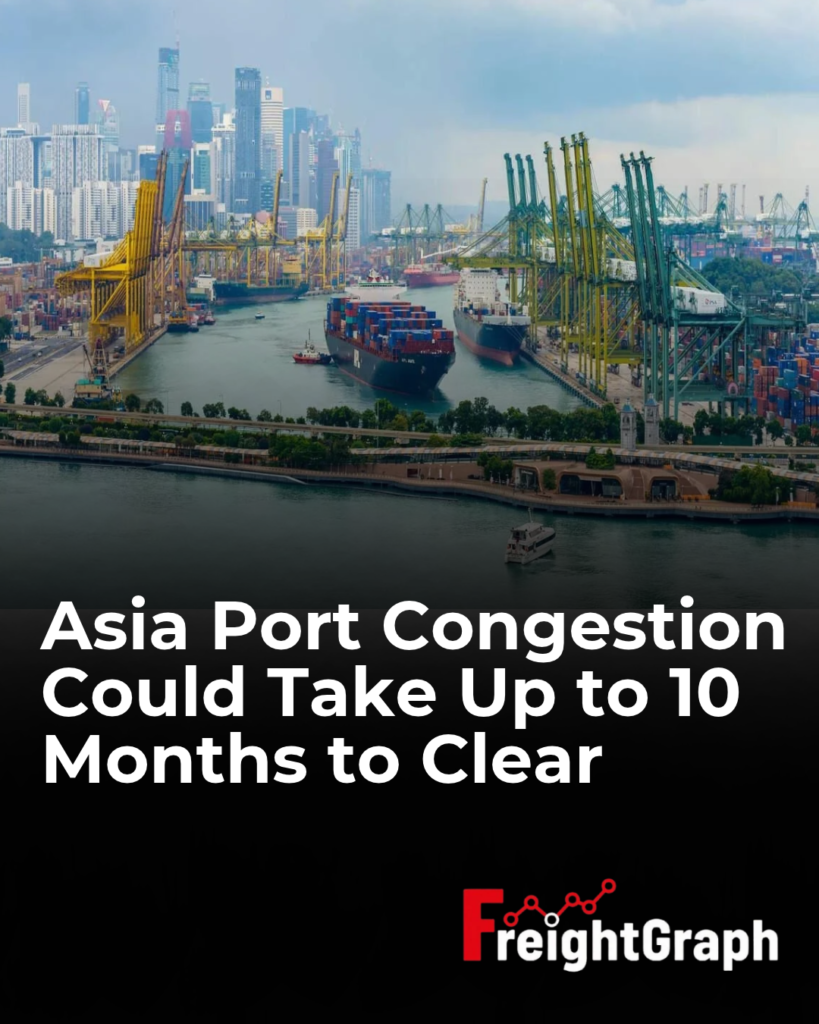
Asia’s container-port congestion is increasingly looking like more than a temporary disruption. Sea-Intelligence estimates that 8.5% of the global containership fleet is currently absorbed by delays—equivalent to roughly 3 million TEU of capacity. Based on recovery patterns following previous major disruptions, the analyst estimates that congestion could take seven to 10 months to return to the relatively low levels recorded in June 2025. That means the effects could potentially stretch well into 2027.
The pressure is already visible at major Asian gateways. Operational data for September 23–29 shows congestion at Shanghai remaining elevated, with terminal waiting times of approximately four to seven days, depending on the terminal, while high yard density and strong cargo volumes continue to affect operations. In Singapore, the previous week’s operational update reported average vessel waiting times of around two days across PSA terminals and yard density of approximately 85%. The broader problem is that congestion can cascade through the network: when vessels skip or change calls at one gateway, cargo and ships can shift toward neighboring terminals, creating new bottlenecks elsewhere.
For shippers, freight forwarders and logistics teams, the story is therefore bigger than a delayed vessel. When millions of TEUs of effective capacity are tied up in congestion, schedules become less predictable and disruption can spread beyond the original port. With analysts warning that normalization could take months rather than weeks, visibility across shipments, documents and operational workflows becomes increasingly important when conditions change quickly. Freight teams can explore how FreightGraph helps bring greater automation and visibility into day-to-day freight operations.