A single mistake on a shipping document can create problems throughout an entire shipment. An incorrect consignee name, missing container number, or inaccurate cargo description may lead to delivery disputes, customs delays, or additional administrative work.
One of the most important documents in freight transportation is the Bill of Lading (BOL).
Whether you are a shipper, freight forwarder, carrier, importer, or logistics manager, understanding how a bill of lading works is essential for managing shipments and maintaining accurate freight records.
This guide explains what a bill of lading is, why it matters, the different types used in logistics, how to complete one, and the most common mistakes to avoid.
What Is a Bill of Lading (BOL)?
A Bill of Lading (BOL or B/L) is a transportation document issued by a carrier or its authorized representative that records the receipt of goods for shipment and sets out important details of the transportation arrangement.
Depending on the type of bill of lading and the applicable law, it can serve three important functions:
- Receipt of goods: Confirms that the carrier has received the cargo described in the document.
- Evidence of the contract of carriage: Records important terms and details of the transportation agreement.
- Document of title: Certain types of bills of lading can be used to transfer rights relating to the goods.
Not every bill of lading is negotiable or functions as a document of title. These characteristics depend on the document type, wording, and governing legal framework.
In practical terms, a BOL helps establish what goods are being transported, who is involved, and where the shipment is expected to go.
Why Is a Bill of Lading Important in Logistics?
A bill of lading connects several parties involved in freight transportation.
It provides a common reference for shipment information, helping carriers, freight forwarders, shippers, and consignees coordinate their responsibilities.
Proof of Cargo Receipt
A BOL can confirm that a carrier received a shipment.
The document may also record the apparent condition of the goods or packaging when they were accepted.
Shipment Identification
A bill of lading includes essential information such as the shipper, consignee, cargo description, quantity, and transportation details.
This information helps parties identify and manage the shipment.
Cargo Release and Delivery
Depending on the document type and contractual arrangement, the bill of lading may play a role in determining who is entitled to receive the goods.
For some ocean shipments, presentation or surrender of an original negotiable bill of lading may be required before cargo is released.
Documentation and Dispute Resolution
When cargo is damaged, delayed, or delivered incorrectly, the bill of lading may provide important evidence of the shipment’s declared details and condition at receipt.
It does not, by itself, establish liability for every cargo claim.
What Information Is Included in a Bill of Lading?
The exact fields depend on the transportation mode, carrier, and document format.
However, most bills of lading contain several common categories of information.
| BOL Field | What It Means |
|---|---|
| Shipper | The party sending or tendering the goods |
| Consignee | The party designated to receive the shipment |
| Notify Party | The party to be informed about shipment arrival, where applicable |
| Carrier | The transportation company responsible under the carriage arrangement |
| Origin | The location where transportation begins |
| Destination | The intended delivery location |
| Cargo Description | Description of the goods being shipped |
| Package Count | Number and type of packages |
| Gross Weight | Total declared weight of the cargo, including relevant packaging |
| Container Number | Identification of the shipping container, when applicable |
| Seal Number | Identification of the container seal, when applicable |
| Freight Terms | Applicable freight payment or contractual terms |
| BOL Number | Reference number assigned to the document |
| Issue Date | Date the document was issued |
Some ocean bills of lading also identify the vessel, voyage, port of loading, and port of discharge.
Accurate data entry is essential because information from the BOL may be used in other shipping documents and logistics systems.
Main Types of Bill of Lading
There are several types of bills of lading, each serving a different purpose.
Understanding these differences helps businesses choose the appropriate documentation for their shipments.
1. Straight Bill of Lading
A straight bill of lading names a specific consignee and is generally non-negotiable.
It is commonly used when goods are intended for delivery to an identified recipient rather than being transferred through endorsement.
Delivery and document presentation requirements still depend on applicable law and the carrier’s procedures.
Common use: Shipments where the recipient is already determined.
2. Order Bill of Lading
An order bill of lading is generally a negotiable document.
It may allow rights associated with the shipment to be transferred through endorsement and delivery of the document, subject to the relevant legal requirements.
Order bills of lading are often associated with international trade transactions where control over the goods is important.
Common use: Certain documentary credit and international trade arrangements.
3. Clean Bill of Lading
A clean bill of lading contains no adverse notation by the carrier about the apparent condition of the goods or their packaging at receipt or loading.
It does not guarantee that the cargo is free from hidden defects or damage.
Common use: Shipments where no apparent damage or packaging issues are recorded.
4. Claused Bill of Lading
A claused bill of lading includes remarks about apparent problems with the cargo or packaging.
For example, the carrier may record that packages were visibly damaged when received.
Common use: Shipments where exceptions to the apparent condition of the cargo need to be documented.
5. Ocean Bill of Lading
An ocean bill of lading is used for maritime cargo transportation.
Depending on its terms, it may be negotiable or non-negotiable.
It typically contains information about the vessel, ports, cargo, and parties involved in the shipment.
Common use: International sea freight.
6. House Bill of Lading (HBL)
A House Bill of Lading is commonly issued by a freight forwarder or non-vessel-operating common carrier (NVOCC) acting as a contractual carrier.
It documents the carriage arrangement between the issuing party and its customer.
Common use: Freight forwarding and consolidated ocean shipments.
7. Master Bill of Lading (MBL)
A Master Bill of Lading is generally issued by the ocean carrier to its contracting customer, which may be a freight forwarder or NVOCC.
It covers the carrier’s transportation arrangement.
Common use: Ocean freight involving shipping lines and freight intermediaries.
8. Electronic Bill of Lading (eBL)
An electronic bill of lading is a digital version of a bill of lading.
When supported by an appropriate legal framework and reliable electronic system, an eBL can perform functions equivalent to those of a paper document.
Electronic bills of lading can reduce document handling and improve access to shipment information.
However, not every electronic shipping record qualifies as a legally effective electronic bill of lading.
House Bill of Lading vs. Master Bill of Lading
House and Master Bills of Lading are particularly important in freight forwarding operations.
| Feature | House BOL (HBL) | Master BOL (MBL) |
|---|---|---|
| Typical Issuer | Freight forwarder or NVOCC | Ocean carrier |
| Contractual Relationship | Forwarder/NVOCC and its customer | Ocean carrier and its contracting customer |
| Primary Purpose | Documents the customer-level carriage arrangement | Documents the ocean carrier’s carriage arrangement |
| Common Usage | Freight forwarding and consolidation | Ocean carrier transportation |
For example, a freight forwarder may arrange an ocean shipment for an exporter.
The forwarder or NVOCC issues a House Bill of Lading to its customer, while the shipping line issues a Master Bill of Lading under its own carriage contract.
The documents may contain different shipper and consignee information because they represent different contractual relationships.
Bill of Lading Example
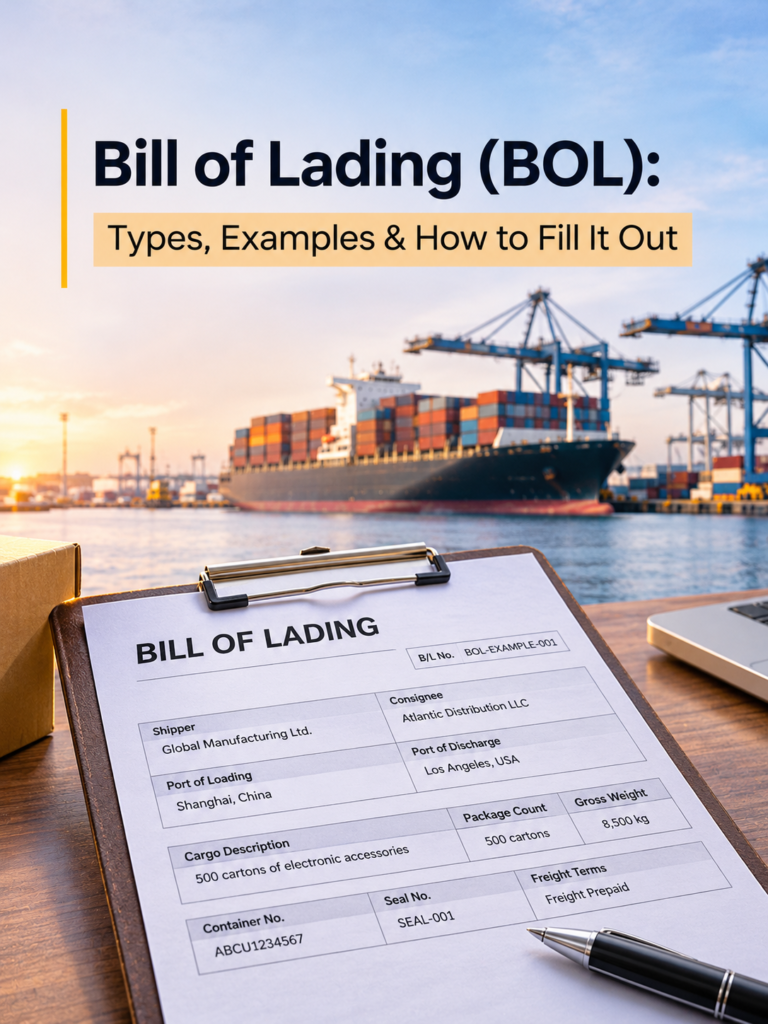
Below is a simplified fictional example of an ocean bill of lading record.
It is intended for educational purposes and is not a carrier-approved or legally operative shipping document.
| Field | Example |
|---|---|
| BOL Number | BOL-EXAMPLE-001 |
| Shipper | Global Manufacturing Ltd. |
| Consignee | Atlantic Distribution LLC |
| Notify Party | Atlantic Distribution LLC |
| Port of Loading | Shanghai, China |
| Port of Discharge | Los Angeles, USA |
| Cargo Description | 500 cartons of electronic accessories |
| Package Count | 500 cartons |
| Gross Weight | 8,500 kg |
| Container Number | ABCU1234567 (illustrative) |
| Seal Number | SEAL-001 (illustrative) |
| Freight Terms | Freight Prepaid |
| Issue Date | 15 October 2026 |
This example demonstrates how shipment information is organized within a bill of lading.
Actual documents may include additional fields, contractual clauses, declarations, and signatures.
The information must match the shipment and applicable carrier requirements.
How to Fill Out a Bill of Lading: Step-by-Step
Completing a bill of lading correctly requires accurate shipment data and careful verification.
The following process provides a practical starting point.
Step 1: Enter the Shipper’s Information
Provide the correct legal name and required contact information for the shipper.
Confirm that the details are consistent with the relevant commercial and shipping records.
Step 2: Identify the Consignee
Enter the party designated to receive the goods.
For negotiable bills of lading, the consignee field may be completed differently according to the required order wording.
Do not assume the same consignee format applies to every shipment.
Step 3: Add the Notify Party
For shipments that require a notify party, provide the correct contact information.
This party is typically informed when the shipment arrives or when relevant delivery arrangements are made.
Step 4: Verify Origin and Destination
Check the applicable pickup location, port of loading, port of discharge, and final delivery location.
These fields are not interchangeable.
Step 5: Describe the Cargo Accurately
Include an accurate description of the goods.
Avoid vague descriptions when more specific information is required.
For example:
Too vague: General goods
More useful: 500 cartons of packaged electronic accessories
The description must reflect the actual cargo and comply with the carrier’s and applicable regulatory requirements.
Step 6: Confirm Package Count, Weight, and Measurements
Verify:
- Number of packages
- Packaging type
- Gross weight
- Cargo measurements, when required
- Container and seal information, when applicable
Inconsistent quantities and weights can create problems during transportation and customs processing.
Step 7: Review Freight Terms
Confirm whether freight charges are recorded as prepaid or collect, where applicable.
These terms should reflect the transportation agreement.
They should not be confused with Incoterms, which address broader responsibilities between buyers and sellers.
Step 8: Check the Document Type
Determine whether the shipment requires a straight, order, or other applicable form of bill of lading.
For ocean freight, verify whether original documents, an electronic bill of lading, or another approved release arrangement will be used.
Step 9: Review and Authorize the Document
Before issuance, compare the information with the booking confirmation, shipping instructions, commercial invoice, and packing list.
Any required corrections should be made through the issuing carrier or authorized party.
Common Bill of Lading Mistakes and How to Avoid Them
Documentation errors can cause delays, additional work, and disputes.
Here are some common mistakes logistics teams should watch for.
Incorrect Shipper or Consignee Information
An incorrect company name or consignee designation may complicate document processing or cargo release.
How to avoid it: Verify party details against the relevant commercial and shipping instructions.
Inaccurate Cargo Description
Vague or incorrect descriptions can create inconsistencies between shipping documents.
How to avoid it: Use a clear description that accurately identifies the goods.
Weight and Quantity Mismatches
Differences between the bill of lading, packing list, and other shipment records can trigger additional checks.
How to avoid it: Validate package counts and weight information before the document is issued.
Incorrect Container or Seal Numbers
Incorrect identification numbers can create operational confusion and complicate cargo verification.
How to avoid it: Compare recorded numbers with the actual equipment and shipment records.
Wrong Document or Release Type
Using the wrong type of bill of lading can create difficulties when transferring or releasing cargo.
How to avoid it: Confirm the document requirements with the contracting parties and carrier before issuance.
Missing Corrections or Version Control
When multiple document versions circulate through email and messaging systems, teams may accidentally work with outdated information.
How to avoid it: Maintain a clear document approval process and a reliable record of changes.
Bill of Lading vs. Sea Waybill vs. Air Waybill
Although these documents may contain similar shipment details, they do not serve identical legal functions.
| Document | Common Transportation Mode | Negotiable? | Typical Purpose |
|---|---|---|---|
| Bill of Lading | Ocean and other freight contexts | Some types are negotiable | Receipt and evidence of carriage; certain types serve as documents of title |
| Sea Waybill | Ocean freight | No | Non-negotiable evidence of carriage and shipment receipt |
| Air Waybill | Air freight | No | Non-negotiable air cargo transportation document |
The correct document depends on the transportation method, commercial arrangement, and applicable requirements.
How Digital Documentation Improves Freight Operations
Managing bills of lading manually can become difficult as shipment volumes increase.
Freight forwarders often receive shipping instructions, invoices, packing lists, and other documents from different customers and transportation partners.
Information may be spread across PDFs, emails, spreadsheets, and separate software systems.
This creates several operational challenges:
- Repeated manual data entry
- Inconsistent shipment records
- Difficulty locating the latest document
- Delays caused by missing information
- Limited visibility across transportation workflows
Digital document management can help address these challenges.
Automated Data Capture
Document processing tools can extract relevant fields from shipping documents.
For example, a system may identify the shipper, consignee, container number, and cargo weight from a bill of lading.
The extracted data should still be validated, especially when source documents are incomplete or inconsistent.
Structured Freight Data
Once information is captured, it can be organized into consistent fields.
This makes shipment records easier to search, compare, and analyze.
Document Validation
Digital workflows can help identify missing fields and inconsistencies between records.
For example, a logistics team may compare the container number in a bill of lading against the corresponding shipment record.
Better Operational Visibility
When shipment data is organized consistently, teams can access relevant information without repeatedly searching through emails and attachments.
This can support more efficient coordination and decision-making.
From Shipping Documents to Freight Intelligence
Bills of lading contain valuable operational information.
However, the information becomes more useful when it can be extracted, organized, and connected with other freight records.
For example, structured shipment data can support analysis of:
- Shipping routes and destinations
- Cargo volumes and shipment patterns
- Carrier and transportation records
- Documentation completeness
- Operational exceptions and recurring errors
At Freight Graph, the focus is on helping logistics teams capture freight data, structure it automatically, and turn fragmented operational information into usable insight.
Instead of treating every shipping document as an isolated file, businesses can work toward more organized and accessible freight information.
Explore Freight Graph to learn more about logistics intelligence and structured freight data.
Bill of Lading Checklist
Before finalizing a bill of lading, review the following items:
- Shipper information is correct.
- Consignee information matches the shipment requirements.
- Notify party details are included where needed.
- Origin and destination information is accurate.
- Cargo description matches the actual goods.
- Package count is verified.
- Gross weight and measurements are checked.
- Container and seal numbers are accurate, when applicable.
- Freight terms match the agreed arrangement.
- The correct document and release type have been selected.
- Required corrections have been approved by the issuing party.
- The final document is stored in the correct shipment record.
This checklist can be incorporated into a standard shipping documentation workflow.
Frequently Asked Questions About Bills of Lading
What is a bill of lading used for?
A bill of lading records the receipt of goods for transportation and provides evidence of the carriage arrangement. Certain types also function as documents of title.
Who issues a bill of lading?
A bill of lading is issued by a carrier or an authorized representative. Freight forwarders and NVOCCs may also issue bills of lading when acting in the relevant contractual capacity.
Is a bill of lading required for every shipment?
No. Documentation requirements depend on the transportation mode, legal framework, and contractual arrangement. Some shipments use other transport documents, such as sea waybills or air waybills.
What is the difference between a BOL and an invoice?
A bill of lading documents transportation-related information, while a commercial invoice records details of a commercial transaction, including the goods sold and their value.
Can a bill of lading be corrected after issuance?
Corrections may be possible, but they generally require coordination with the issuing carrier or authorized party. The procedure depends on the document type and whether original documents have already been released.
What is a negotiable bill of lading?
A negotiable bill of lading is a document that may allow rights relating to the goods to be transferred through endorsement and delivery, subject to the applicable law and document terms.
What is an electronic bill of lading?
An electronic bill of lading is a digital transport document that can perform the relevant functions of a paper bill of lading when the necessary legal and technical requirements are met.
What is the difference between a House BOL and a Master BOL?
A House Bill of Lading is typically issued by a freight forwarder or NVOCC to its customer, while a Master Bill of Lading is issued by the ocean carrier under its own transportation arrangement.
Conclusion
A bill of lading is one of the most important documents in freight transportation.
It helps identify shipments, record transportation details, and support coordination between shippers, carriers, freight forwarders, and consignees.
Understanding the different types of bills of lading and knowing how to complete them correctly can help businesses reduce documentation errors and improve shipping operations.
As freight operations become increasingly data-driven, managing shipping documents effectively is also an important part of building more reliable logistics processes.
Accurate documentation is the starting point. Organized freight data makes that information more useful.
Disclaimer: This article provides general educational information. Bill of lading requirements, legal effects, and cargo release procedures vary by jurisdiction, transportation mode, carrier, and contractual terms. Consult the relevant carrier or qualified professional for shipment-specific requirements.