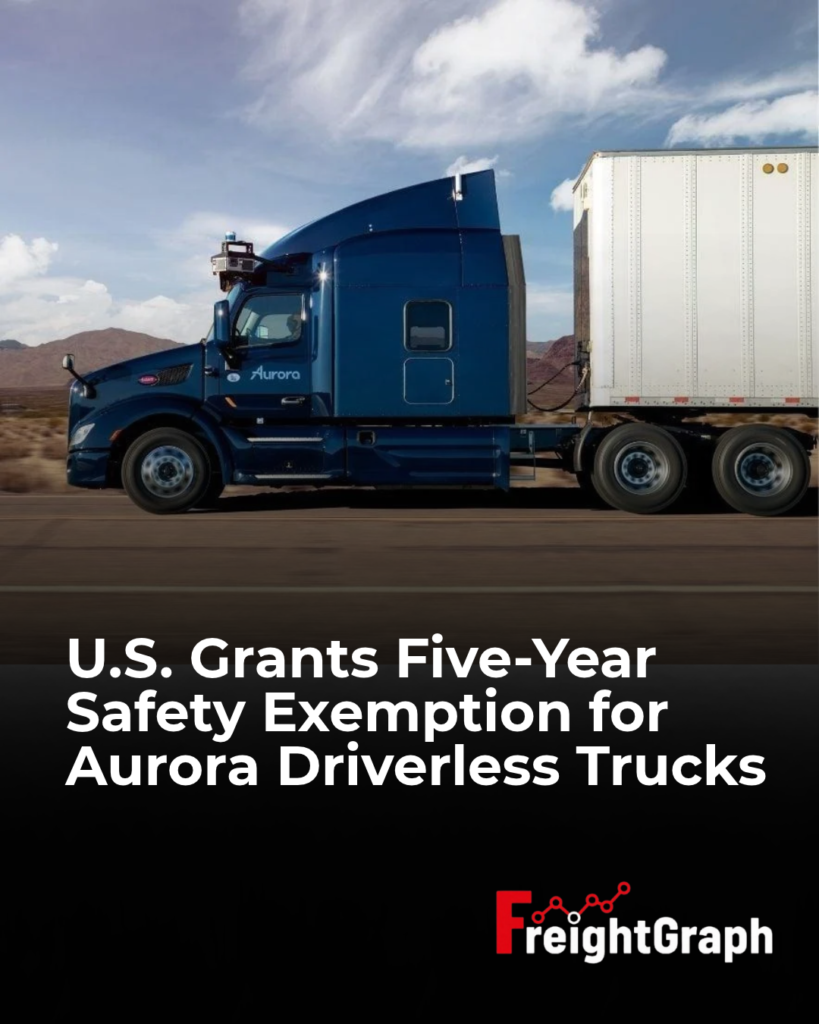
The U.S. Department of Transportation has approved a five-year safety exemption for Aurora and other eligible autonomous trucking operators, allowing them to use cab-mounted warning beacons instead of placing traditional reflective warning devices around stopped trucks. The exemption, effective October 7, 2026, addresses a regulatory requirement originally designed for human drivers. Under the new arrangement, eligible Level 4 autonomous trucks can alert approaching motorists using high-visibility warning lights without requiring a person to exit the vehicle and manually position roadside warning triangles. Federal regulators determined that the alternative system is likely to provide an equivalent or greater level of safety when operated under the exemption’s specified conditions.
The decision follows several years of regulatory discussions. Aurora and Waymo initially sought an exemption in 2023, while Aurora submitted a separate application for a five-year exemption in 2026. The company had previously received a temporary waiver in October 2025, allowing it to test cab-mounted warning beacons in real-world operations. According to the federal regulatory filing, Aurora reported operating 34 commercial vehicles equipped with the warning system over more than 500,000 miles during an earlier waiver period. Reuters reported that Aurora had approximately 20 self-driving trucks in on-road operations at the time of the announcement. Operators seeking to use the new exemption must notify the Federal Motor Carrier Safety Administration and report qualifying crashes involving the warning system.
The exemption removes a specific operational obstacle for commercial autonomous freight transportation, but it does not eliminate other federal or state safety requirements. The FMCSA can revoke the exemption if its conditions are violated or safety performance falls below the required standard. The decision is relevant to freight carriers and logistics providers evaluating how driverless vehicles may fit into transportation networks. Alongside advances in vehicle automation, digital tools such as freight matching technology support a different part of freight operations by helping logistics teams evaluate loads, available capacity, and operational requirements.