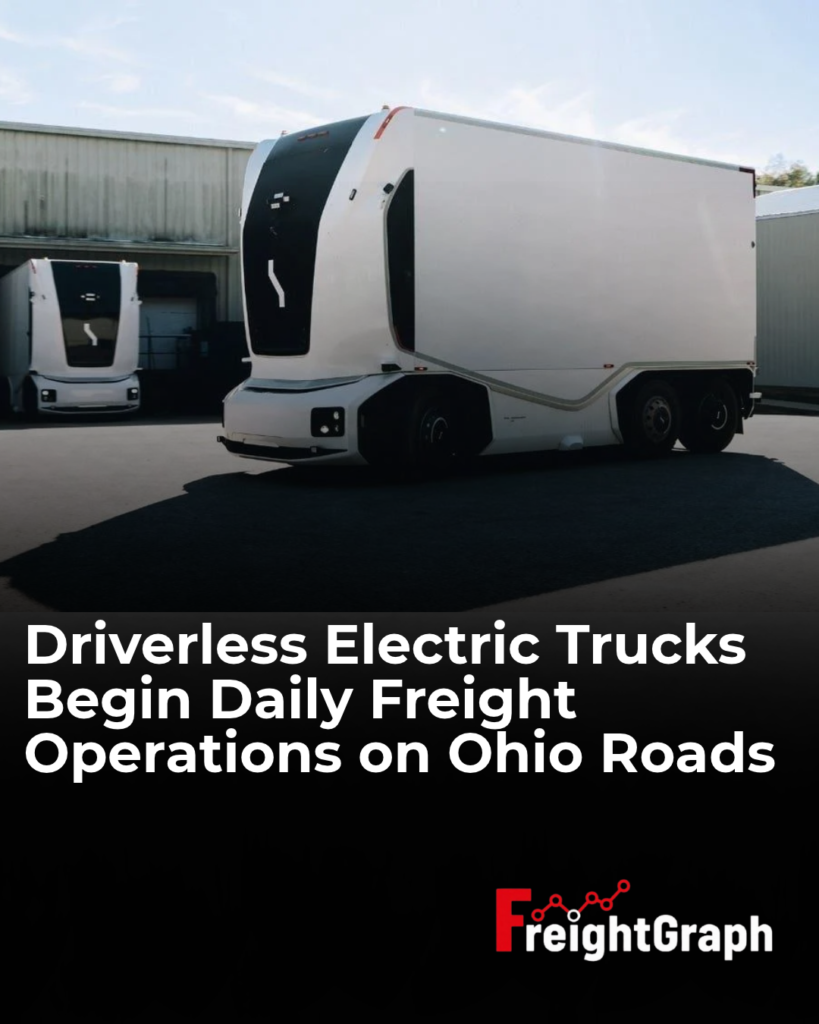
Einride and EASE Logistics have launched daily freight operations using two SAE Level 4 autonomous electric trucks in Marysville, Ohio. Announced on October 6, 2026, the deployment marks the transition from an earlier proof-of-concept initiative to scheduled freight transportation between EASE Logistics warehouses. The cab-less trucks operate on company property and local public roads without anyone onboard, while remote operators monitor each vehicle and can intervene when necessary. The deployment is part of the Ohio–Indiana Truck Automation Corridor Project, involving the Ohio Department of Transportation (ODOT), DriveOhio, and the Indiana Department of Transportation (INDOT).
The project was initially announced in May 2026, with operations beginning in September. Since then, the trucks have been transporting freight between EASE facilities while generating operational data on safety, reliability, and efficiency. Einride and EASE Logistics plan to use information such as miles driven, loads transported, and vehicle uptime to evaluate future expansion. According to Einride, the deployment demonstrates how its purpose-built autonomous technology combines driverless operation with remote oversight in real-world freight environments. For EASE Logistics, this represents its third autonomous trucking deployment with DriveOhio.
The Marysville operation represents a practical step in the development of autonomous freight transportation, moving beyond controlled demonstrations into recurring logistics activities. Although the deployment currently involves only two vehicles operating on defined routes, it provides operational experience for evaluating how autonomous electric trucks could support future freight networks. As transportation technology evolves, solutions involving freight matching and digital logistics operations remain relevant to the broader discussion of how logistics companies coordinate freight movements, manage transportation information, and improve operational visibility.